Disease-causing Autoantibody (aAb) Discovery
Discovering novel disease-causing autoantibodies by leveraging both existing technologies (PhIP-seq, MIPSA, HuProt) and developing new screening platforms.
Background
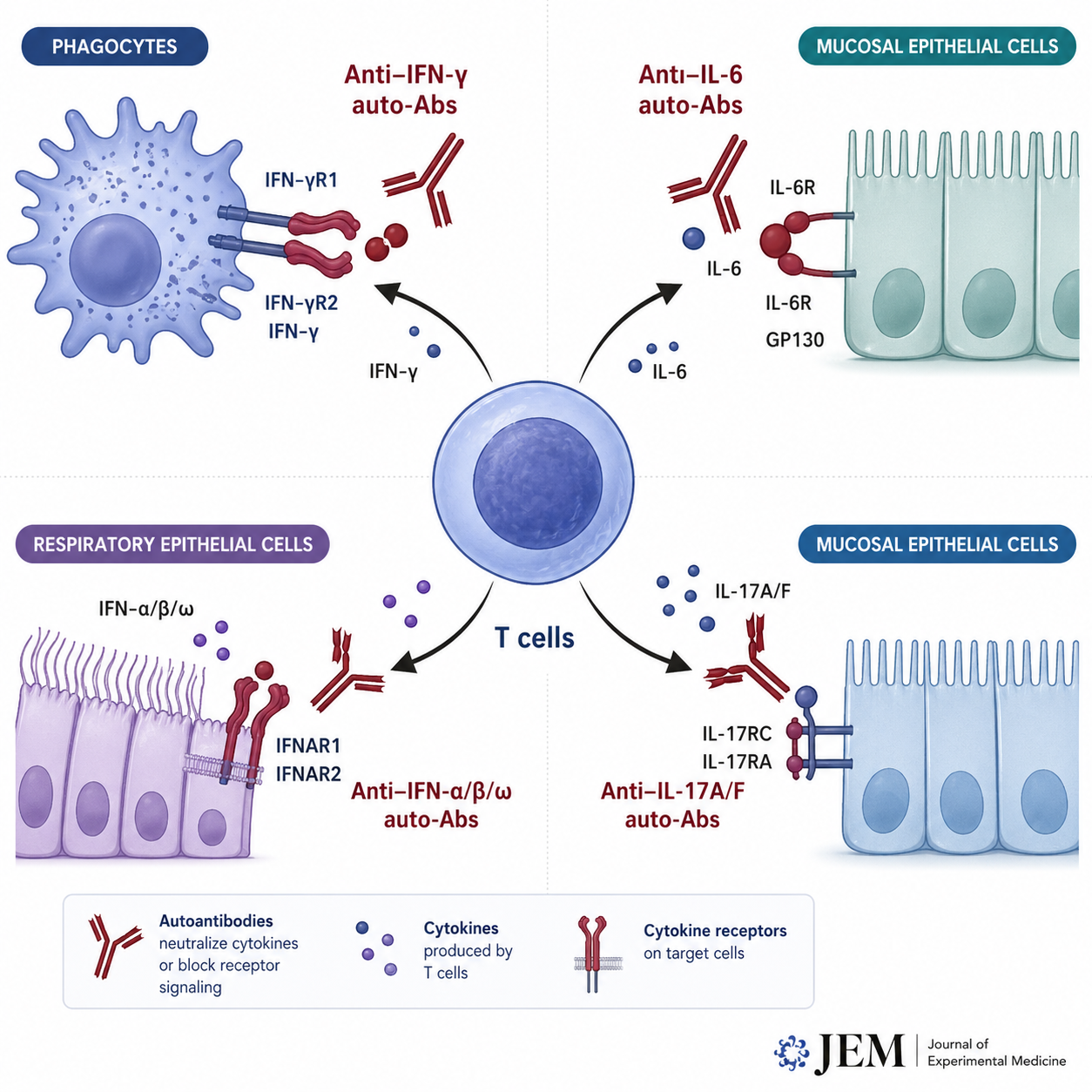
Neutralizing anti-cytokine autoantibodies can create an acquired phenocopy of an inborn error of immunity by functionally blocking a cytokine or receptor pathway that is genetically intact. As a result, patients can develop the same narrow infectious susceptibility seen in genetic defects of that pathway, such as anti-IFN-gamma autoantibodies causing MSMD-like mycobacterial disease or anti-IL-17A/F autoantibodies causing chronic mucocutaneous candidiasis.
Our Approach
We leverage existing autoantibody screening technologies to screen patients with severe unexplained autoimmune and infectious phenotypes who have negative genetic testing.
We are also interested in developing novel autoantibody screening platforms.
Selected Publications
(As we are in the process of building our independent research program, representative publications are drawn from the PI’s prior training.)
Manry J, Bastard P, Gervais A, Le Voyer T, Rosain J, Philippot Q, Michailidis E, Hoffmann HH, Eto S, Garcia-Prat M, Bizien L, Parra-Martinez A, Yang R, et al.
The risk of COVID-19 death is much greater and age dependent with type I IFN autoantibodies.
PNAS. 2022;119(21):e2200413119.
DOI: 10.1073/pnas.2200413119
Bastard P, Gervais A, Le Voyer T, Rosain J, Philippot Q, Manry J, Michailidis E, Hoffmann HH, Eto S, Garcia-Prat M, Bizien L, Parra-Martinez A, Yang R, et al.
Autoantibodies neutralizing type I IFNs are present in approximately 4% of uninfected individuals over 70 years old and account for approximately 20% of COVID-19 deaths.
Science Immunology. 2021;6(62):eabl4340.
DOI: 10.1126/sciimmunol.abl4340
Bastard P, Rosen LB, Zhang Q, Michailidis E, Hoffmann HH, Zhang Y, Dorgham K, Philippot Q, Rosain J, Beziat V, Manry J, Shaw E, Haljasmagi L, Peterson P, Lorenzo L, Bizien L, Yang R, et al.
Autoantibodies against type I IFNs in patients with life-threatening COVID-19.
Science. 2020;370(6515):eabd4585.
DOI: 10.1126/science.abd4585